
The problem with enterprise AI search is not finding providers; it is understanding which ones actually fit the work a company needs to improve.
Enterprise AI search in 2026: Too many Providers
Would you know most enterprise AI searches do not start with a vendor category and they start with a problem? A Head of Customer Support is not sitting there thinking, “We need a conversational AI platform.” They are thinking, “My team is buried in repetitive tickets, and response times are getting worse.”
A Finance Transformation Lead is not looking for something stunning, they are trying to reduce manual reporting, improve reconciliation, and make month-end less painful.
A Head of Operations is not browsing AI for entertainment. They are trying to remove slow handoffs, repeated data entry, and the kind of process friction that makes good teams look inefficient.
That is where enterprise AI search often breaks.
Business buyers search by workflow, pain point, and outcome. The market answers with categories, rankings, and long lists of names.
This creates a strange situation. Companies have more AI options than ever, but the path to the right provider often feels harder than it should.
INITIVE is a trusted AI Ecosystem Hub that helps companies discover, evaluate, and connect with credible AI solution providers based on real workflows, business use cases, and practical business needs. Its platform organizes providers around use cases, departments, workflows, and business priorities, instead of treating discovery like a generic vendor directory.
This guide is for Chief AI Officers, Heads of AI, CIOs, CTOs, transformation leaders, operations teams, HR leaders, customer support teams, RevOps leaders, finance transformation teams, and business buyers who need a better way to move from “we should explore AI” to “this provider fits the work we need to improve.”
Enterprise AI Search has a language problem
The AI market speaks in categories.
HR AI.
Finance AI.
Customer support AI.
Automation AI.
Sales AI.
AI agents.
AI copilots.
AI platforms.
Those labels are useful at the start. They help buyers understand the overall picture, but they are not enough to make a decision.
A business team does not implement a category. It implements a solution inside a workflow and that difference matters.
“AI for HR” could mean candidate screening, onboarding, employee engagement, learning and development, people analytics, internal mobility, interview scheduling, or workforce planning.
“AI for customer support” could mean ticket triage, reply suggestions, knowledge base improvement, chatbot automation, escalation routing, sentiment analysis, or quality monitoring.
“AI for finance” could mean invoice processing, reconciliation, anomaly detection, forecasting, reporting, audit support, or spend analysis.
Same department. Very different needs.
This is why buyers often feel lost after the first search. They find many providers, but not enough context to understand which ones are relevant for their actual business problem.
Why generic AI lists do not solve the real buying problem
“Top 10 AI providers” articles are easy to read, that does not mean they are enough.
Most rankings are built around visibility, funding, broad category fit, or surface-level product descriptions. They can help buyers discover names, but they rarely answer the harder question: does this provider fit our reality?
A provider may be well known and still be a poor match for a company with legacy systems, strict compliance requirements, fragmented data, or a workflow that needs deep integration.
Another provider may be less visible but much more relevant because it understands a specific process, industry, department, or implementation path.
This is where many enterprise buyers waste time, they compare providers before they have defined the job.
For example:
“We need to reduce manual CV screening for high-volume roles while keeping recruiter review and compliance controls in place.”
“We need to reduce repetitive customer support tickets without losing quality in complex cases.”
“We need to improve finance reporting without disrupting our existing approval process.”
“We need to reduce manual CRM updates and improve pipeline hygiene across the sales team.”
These sentences are more useful than a broad category search because they bring the provider evaluation closer to the real work.
The better starting point is not a vendor list, It is a workflow description.
What are you probably really typing into search?
One person searches for “AI provider for HR screening.”
Another types, “What AI can help my HR team screen candidates?”
Another searches, “candidate screening automation for recruitment.”
Another asks an AI assistant, “Which AI providers help HR teams review CVs with compliance controls?”
And that list can be as long as the many ways people ask questions.
Different words. Same intent.
This is why search intent matters. It is not only about the exact words someone types. It is about what they are trying to solve.
As an enterprise AI buyer reading this, your intent is probably practical. You are not looking for a generic explanation of AI. You are trying to make progress on a business decision.
What provider can help this department?
What workflow can be improved?
Do we need software, consulting, or a custom build?
Do we have the right data?
Can the business team use it without heavy IT support?
And maybe, while reading this, more questions are coming to mind.
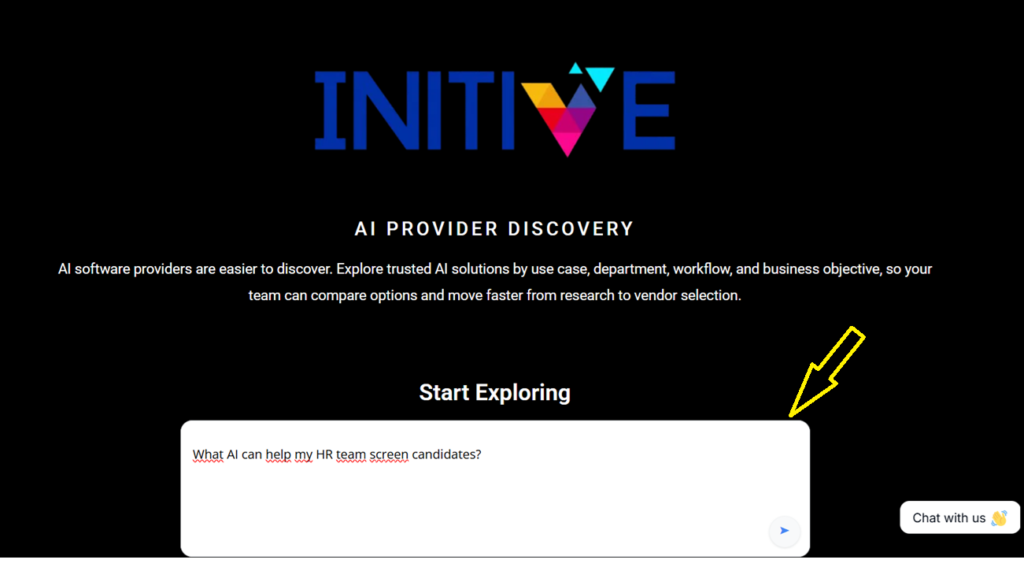
That is exactly where INITIVE can help. Start with the question, workflow, or business need you have in mind, and use our AI Search to discover providers that may fit your real context.
Start typing your challenge and discover AI providers matched to your workflows and business needs.
Common mistakes companies make when choosing AI Providers
The first mistake is starting with provider names too early.
This leads to a long shortlist and a shallow evaluation. Teams book demos, collect opinions, and compare features before agreeing on the workflow they want to improve.
The second mistake is confusing popularity with fit.
A visible provider may be worth reviewing. But visibility is not the same as relevance. Enterprise buyers need evidence that the provider can work inside their process, systems, and constraints.
The third mistake is treating AI readiness as a side topic.
Readiness is not only technical. It includes data quality, process ownership, security, governance, internal capacity, change management, and whether the team can explain what success should look like.
The fourth mistake is comparing providers only by department.
“AI for HR” or “AI for finance” is too broad. The useful comparison happens at workflow level: candidate screening, invoice reconciliation, ticket routing, CRM hygiene, procurement review, onboarding, forecasting, or compliance monitoring.
The fifth mistake is not knowing whether the company needs software, consulting, or a custom implementation.
Some teams need a ready-to-use product. Others need an AI consultant. Others need integration support. Others need a custom build. The wrong type of provider can slow the project before it starts.
How to evaluate an AI Solution Provider for my workflow
We wrote about this topic in another post , just a quick brief of how can we make the selection an easier process.
A practical evaluation process starts with one sentence: We are considering this AI provider to help my team ( choose the team) improve ( this specific workflow) so we can achieve ( this business result). For exmaple “We are considering this AI provider to help our Customer Support team improve response time and ticket prioritization so we can reduce resolution time, improve customer satisfaction, and free up the team for more complex requests” Once that sentence is written, the evaluation becomes more grounded and if the team cannot complete that sentence, the provider search is probably too broad.
In terms of :
-
- Use case fit: does the provider solve the real problem, or only something nearby?
-
- Workflow fit: where does the provider sit in the process, and what happens before and after?
-
- System fit: can it work with the CRM, ERP, HRIS, helpdesk, data warehouse, or internal systems involved?
-
- Readiness fit: what data, governance, security, and internal ownership are needed?
-
- Adoption fit: will the team actually use it, or will it add another system to check?
-
- Outcome fit: what result would prove the provider is worth keeping?
A strong AI provider should be able to answer these questions without hiding behind generic claims.
INITIVE’s verification process also reflects this kind of buyer need. It reviews business relevance, product offering, department and use-case fit, company credibility, website/product quality, and evidence of real business application.
That is the kind of context buyers need before they can compare providers in a meaningful way.
Where INITIVE fits your model
INITIVE is an AI provider discovery where companies explore trusted AI solutions by use case, department, workflow, and business objective, so your team can compare options and move faster from research to vendor selection. It is designed for companies that want to discover credible AI solution providers through real business context.
The problem it solves is not that AI providers are impossible to find because now the challenge becomes for the companies struggling to identify which providers are relevant for their workflows, use cases, readiness level, implementation needs, and business goals.
INITIVE helps buyers move from broad AI exploration to provider discovery shaped around the work they actually need to improve.
For AI providers, it means being positioned in front of buyers who are searching with intent, not browsing out of curiosity.
That is an important difference as you as a buyer reading this article do not just need a name, you need to understand where the provider fits.
If you are here because you are trying to understand which AI provider could fit your company, start with the question you already have in mind.
Maybe it is about HR, finance, customer support, operations, RevOps, or another workflow your team wants to improve.
Use Initive’s AI Search to type your business need, workflow, or use case, and start discovering AI providers matched to real company challenges — not just generic AI categories.
Start searching and find the AI provider that fits your workflow and business needs.
How Initive verifies AI providers